
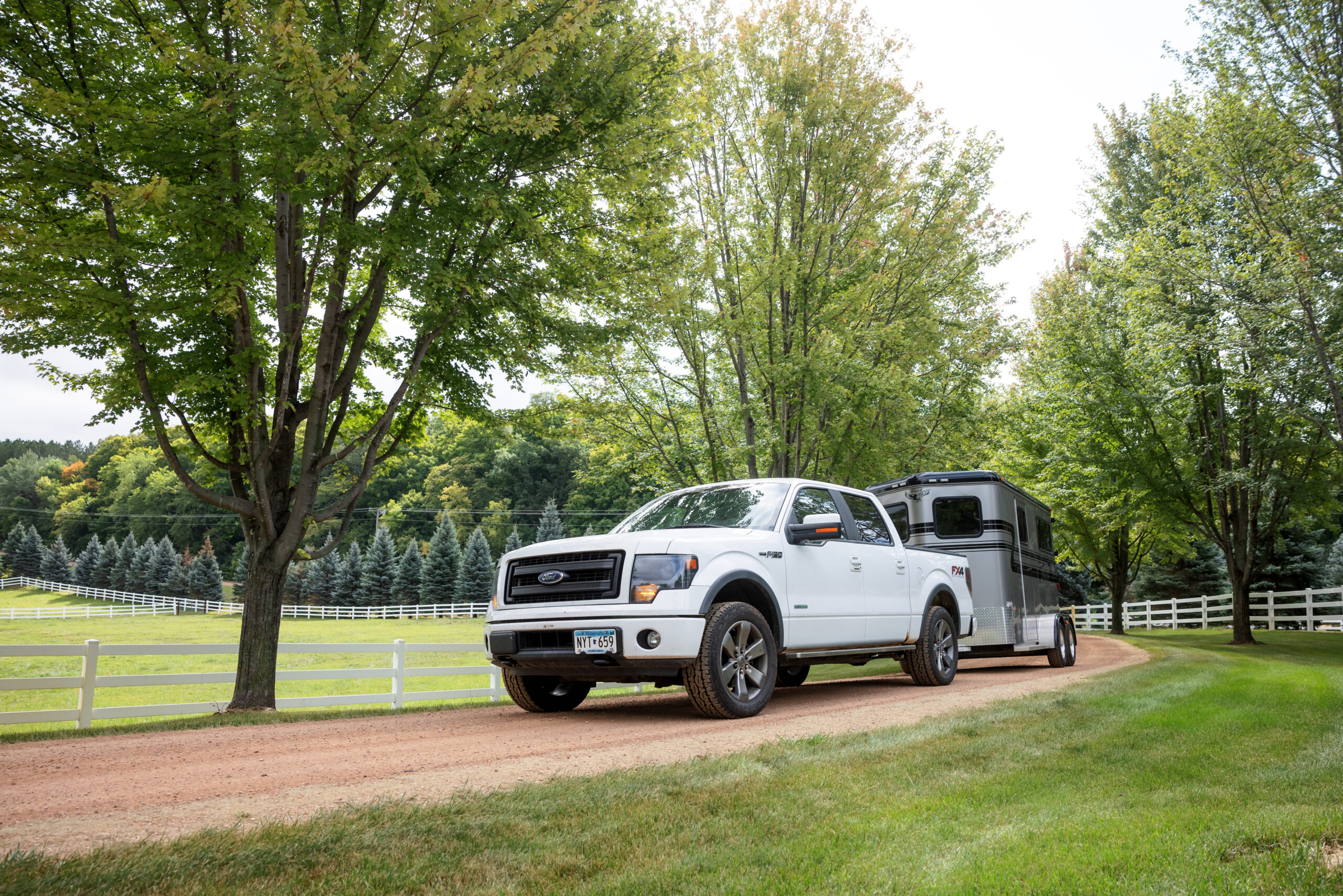
Ask most gooseneck or living-quarters haulers what their truck can handle, and they’ll tell you the tow rating printed in the brochure. Ask what their actual payload capacity is, and you’ll often get a blank look. That gap is where a lot of experienced haulers end up overloaded without realizing it — technically under their tow rating, but well past what their truck is built to carry.
Two different numbers, two different limits
Tow rating measures how much weight your truck can pull. Payload measures how much weight your truck can carry — in the bed, in the cab, and, critically, on the hitch itself. For a gooseneck or fifth-wheel setup, pin weight (the portion of the trailer’s weight resting on the truck) typically runs 15–25% of the trailer’s total loaded weight, compared to roughly 10–15% for a conventional bumper-pull tongue. That pin weight comes straight out of your payload, not your tow rating.
Do the math on a loaded 16,000-lb gooseneck trailer at 20% pin weight, and you’re putting around 3,200 lbs on the truck before a single passenger climbs in or a hay bale gets loaded. Add water, tack, feed, and people, and many half-ton — and even some three-quarter-ton — trucks run out of payload long before they come anywhere near their advertised tow number.
Where the payload actually goes
For haulers running living-quarters trailers, the payload math gets tighter, not looser. Front-living-quarters models push the axles further back, which increases pin weight relative to a stock trailer of similar length. Add a full water tank, a loaded tack room, and two or three people in the truck, and it’s easy to be several hundred pounds over payload while still sitting comfortably under the truck’s tow rating on paper.
Where to find your real number
Your truck’s actual payload capacity isn’t the number in the sales brochure — it’s on the yellow or white sticker inside the driver’s door jamb, and it’s specific to your truck’s exact configuration (cab size, bed length, axle, options). Subtract your truck’s actual weight, passengers, fuel, and gear from that number, then subtract your pin weight, and what’s left is what you have to work with. The only way to know for certain is to weigh the loaded rig — truck and trailer together — at a CAT scale.
Keep the load where it belongs
Once you know your real payload margin, load distribution still matters. The standard rule of thumb is roughly 60% of the trailer’s cargo weight ahead of the axles, which keeps enough weight on the hitch to prevent sway without overloading the truck. Too little weight forward and the trailer can start to fishtail at highway speed; too much, and you’ve eaten into payload you didn’t have to spare. Seasoned haulers already respect their tow rating. The number worth checking twice — every time the load changes — is payload. It’s the one that’s easy to exceed quietly, and the one that actually determines whether your rig is loaded the way it was built to be